
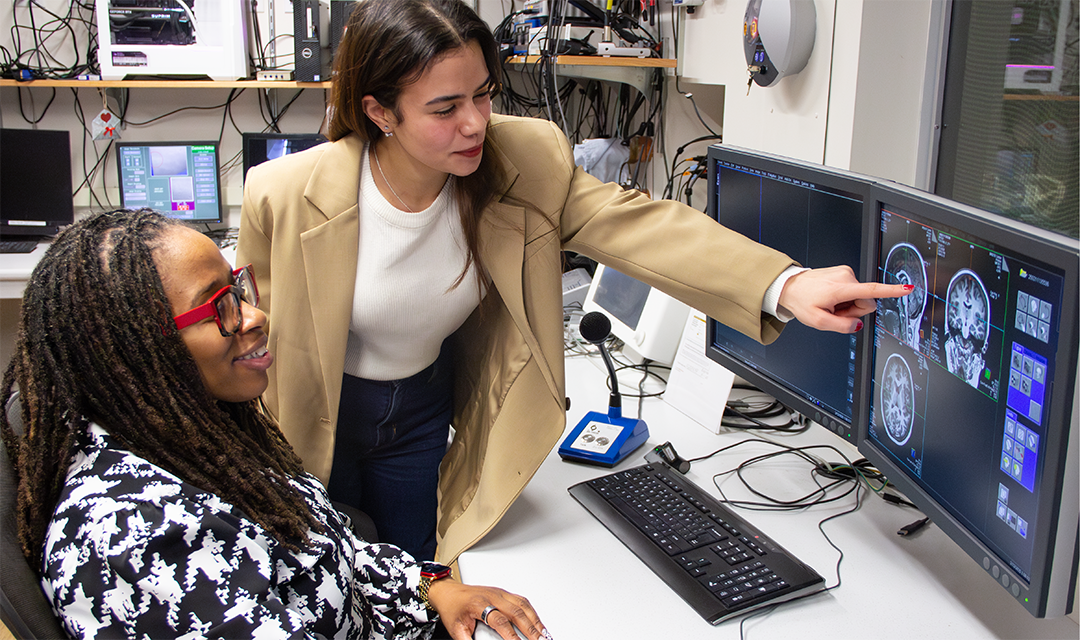
CMU’s biomedical engineering master’s programs prepare engineers, scientists, and innovators to advance healthcare through research, technology, and interdisciplinary collaboration. Built on CMU's collaborative approach to engineering and discovery, our programs combine flexible degree options, customizable coursework, and hands-on research to help students develop the knowledge and skills needed to tackle today's most pressing biomedical challenges.
Whether you're advancing your expertise in biomedical engineering, transitioning from another technical discipline, or preparing for doctoral study, you’ll tailor your education to your professional goals. With opportunities to explore areas such as biomaterials, biomechanics, biomedical imaging, neuroengineering, medical device design, and computational modeling, graduates are well positioned for careers in biotechnology, healthcare, research and development, and beyond.
Master of Science in Biomedical Engineering
The M.S. in Biomedical Engineering program provides advanced, course-based training designed to build both depth and breadth across the field. Ideal for students with backgrounds in biomedical engineering, traditional engineering, or the sciences, the program offers the flexibility to tailor coursework to diverse interests and career goals. Students may use the degree to advance careers in biotechnology, medical devices, healthcare, and research, transition into biomedical engineering from another discipline, or strengthen their preparation for doctoral or medical studies. The program also serves as the foundation for cross-disciplinary degree options, including the Dual M.S. in Biomedical Engineering and Engineering & Technology Innovation Management.
Master of Science in Biomedical Engineering - Applied Study
The M.S. in Biomedical Engineering – Applied Study program combines advanced, course-based education with hands-on professional experience in a real-world setting. In addition to completing graduate coursework, students satisfy a practical training requirement through an internship, clinical practicum, or faculty-guided research experience. Typically completed in 16 months of full-time study, the program equips graduates with both technical expertise and practical experience for careers in biotechnology, medical devices, healthcare, and other biomedical engineering industries.
Master of Science in Biomedical Engineering - Research
The M.S. in Biomedical Engineering – Research program prepares students for careers that require advanced technical knowledge and independent research experience. Alongside graduate coursework, students conduct original research under the guidance of one of nearly 50 biomedical engineering faculty members whose expertise spans fundamental, translational, experimental, and computational research. Students explore research opportunities early in the program before joining a faculty laboratory and completing a thesis or peer-reviewed publication. Typically completed in 21 months, the program provides excellent preparation for research and development careers or continued Ph.D. study.
Master of Science in Artificial Intelligence - Biomedical Engineering
The M.S. in Artificial Intelligence Engineering – Biomedical Engineering program prepares students to harness the power of AI and machine learning to solve some of healthcare's most complex challenges. As artificial intelligence transforms medicine, students gain the interdisciplinary expertise needed to develop intelligent solutions for disease diagnosis, treatment planning, medical imaging, biological signal processing, brain-computer interfaces, neuroprosthetics, and other emerging healthcare technologies that improve patient outcomes and quality of life.
Designed for students with undergraduate degrees in engineering or related technical disciplines, this accelerated three-semester program combines artificial intelligence, biomedical engineering, engineering design, and system analysis to prepare graduates for careers at the intersection of AI and healthcare. Students develop both AI expertise and domain knowledge in biomedical engineering, positioning them for roles in medical devices, digital health, biotechnology, healthcare technology, and biomedical AI research.
Learn more about the Master’s of AI Engineering programs
Master of Science in Artificial Intelligence - Biomedical Engineering - Research
The M.S. in Artificial Intelligence Engineering – Biomedical Engineering – Research is designed for students who want to drive the next generation of AI-enabled healthcare discoveries. As artificial intelligence reshapes biomedical research and clinical care, students combine advanced study in AI, machine learning, and biomedical engineering with original research that explores new approaches to diagnosis, medical imaging, biological signal analysis, neuroprosthetics, and other emerging healthcare technologies.
Over the course of this 21-month program, students work closely with Carnegie Mellon faculty and collaborators at leading clinical and research institutions—including the Mayo Clinic, University of Pittsburgh Medical Center (UPMC), and Allegheny Health Network (AHN)—to conduct independent research that culminates in a thesis or peer-reviewed publication. Graduates leave prepared for research and development careers, doctoral study, and leadership roles advancing AI-driven healthcare innovation.
Learn more about the Master’s of AI Engineering programs
Dual Master of Science in Biomedical Engineering and Engineering & Technology Innovation Management
The Dual M.S. in Biomedical Engineering and Engineering & Technology Innovation Management (E&TIM) prepares future leaders to transform biomedical innovations into real-world impact. Combining advanced technical training in biomedical engineering with expertise in technology commercialization, innovation strategy, and engineering leadership, this interdisciplinary 21-month program equips graduates to lead the development and deployment of next-generation healthcare technologies.
Students begin in the Biomedical Engineering M.S. program, complete one year in the E&TIM program (including a summer internship), and then return to Biomedical Engineering to complete their degree requirements. The integrated curriculum allows select coursework to count toward both degrees, providing an efficient pathway to careers in biotechnology, medical devices, healthcare innovation, entrepreneurship, and technology management.
Research areas
Explore the department's diverse research areas and discover how you can contribute to innovative projects that advance biomedical engineering and improve human health: