
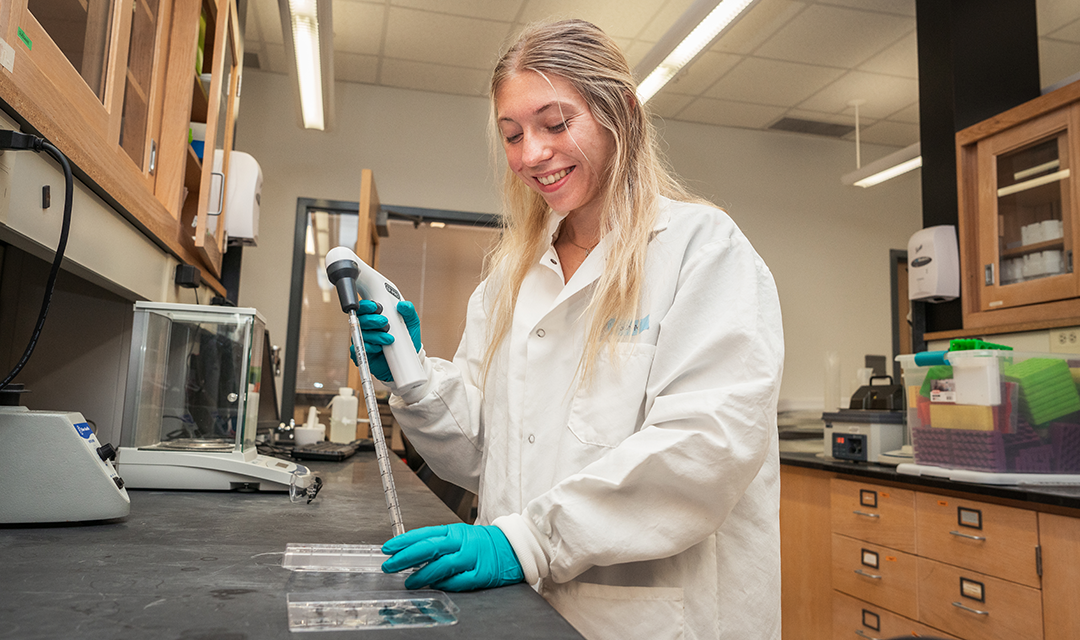
At Carnegie Mellon, you’ll do more than study biomedical engineering—you’ll learn to engineer solutions that improve human health. Our undergraduate Biomedical Engineering program combines rigorous training in a traditional engineering discipline with specialized biomedical coursework. You will be provided with the technical depth and interdisciplinary perspective to tackle complex challenges at the intersection of engineering, biology, and medicine. Whether you’re interested in medical devices, biomechanics, tissue engineering, neuroengineering, or computational medicine, you'll develop the knowledge and problem-solving skills to make a meaningful impact.
Why students choose CMU BME

“Although BME is an additional major at CMU, the department has never felt like a smaller part of my experience. In Introduction to BME, faculty came in one by one to present their own labs and invite students to join them, so I was talking with researchers from my very first semester. Balancing ChemE, BME, and pre-medical requirements is an unusual path, but my professors have advised students on it before, and they take those goals seriously.”
- Ramit Dasika, Undergraduate student (ChemE/BME) and BMES President (2026-27)

“Being a part of the BME community has allowed me to grow both personally and professionally. With professors who really care about your learning and the hands-on nature of the courses, it has allowed me to explore so many pathways within biomedical engineering and find my passion. Not only has coursework been meaningful, but through peers and professors, I know I have a network that I can carry with me outside of campus that will support me and allow me to continue to grow after graduation.”
- Olivia LaFond, Undergraduate student (ChemE/BME)
Post-graduation outcomes
96%
Employed or in grad school
$79,700
Average starting salary
Classes of 2021 through 2025, six months after graduation
Graduates go on to...
Work for companies like:
- Cleveland Clinic
- Deloitte
- Medtronic
- Merck
- Proctor & Gamble
- U.S. Food and Drug Administration
Pursue graduate degrees at universities like:
- Carnegie Mellon University
- Harvard Medical School
- Stanford University
- University of Illinois
- University of Pittsburgh
- Yale University School of Medicine
Undergraduate programs
Carnegie Mellon’s undergraduate Biomedical Engineering (BME) program is offered as an additional major, allowing students to pair biomedical engineering with a primary degree in Chemical, Civil & Environmental, Electrical & Computer, Materials Science, or Mechanical Engineering. An additional major in Biomedical Technology is another option and is open to non-engineering majors. By leveraging shared coursework across programs, students can complete both majors in four years with only a modest increase in degree requirements.
This distinctive curriculum draws on expertise from across the College of Engineering and collaborations with leading medical institutions in Pittsburgh and beyond. Students complete a strong biomedical engineering core before pursuing specialized coursework aligned with their interests, preparing them to address complex healthcare challenges through an interdisciplinary approach.
Additional Major in Biomedical Engineering
The biomedical engineering curriculum is designed to provide a strong foundation in the primary engineering major–Chemical, Civil, Environmental, Electrical & Computer, Materials Science, or Mechanical–while giving you the flexibility to develop specialized expertise aligned with your interests. Through a combination of rigorous coursework and hands-on learning, you’ll gain the knowledge and practical experience needed to address complex challenges in healthcare and biomedical innovation. Begin with a comprehensive biomedical engineering core, then customize your education through focused tracks. You’ll complete your experience with a multidisciplinary capstone design project, collaborating with peers to develop innovative solutions to real-world biomedical challenges.
Core courses
The following core courses are required for students pursuing an additional major in Biomedical Engineering.
- 03-121 Modern Biology or 03151 Honors Modern Biology - Fall and Spring
- 42-101 Introduction to Biomedical Engineering - Fall and Spring
- 42-201 Professional Issues in Biomedical Engineering - Fall and Spring
- 42-202 Physiology - Fall and Spring
- 42-203 Biomedical Engineering Laboratory# - Fall and Spring
- 42-302 Biomedical Engineering Systems Modeling and Analysis - Fall and Spring
- 42-401 Foundations of Biomedical Engineering Design* - Fall
- 42-402 Biomedical Engineering Design Project* - Spring
# Also known as 03-206 for Health Professions Program students.
* 42-401 serves as the precursor/pre-requisite for 42-402 Biomedical Engineering Design
Requirements
Students pursuing the Biomedical Engineering or Technology additional majors complete requirements in three areas: Biomedical Engineering or Technology, their primary major, and general education. To remain in good standing, students must maintain a minimum 2.00 Quality Point Average (QPA) in courses that count toward the additional major. Courses taken on a pass/fail or audit basis may not be applied toward Biomedical Engineering or Technology degree requirements.
Additional Major in Biomedical Technology
The Biomedical Technology curriculum is designed for students outside the College of Engineering who want to build a strong foundation in biomedical engineering while complementing their primary field of study. Through a combination of rigorous coursework and hands-on learning, you'll gain the technical knowledge and practical experience needed to contribute to healthcare innovation from an interdisciplinary perspective. Begin with a comprehensive Biomedical Technology core, then customize your education through focused tracks aligned with your interests. You'll complete your experience with a multidisciplinary capstone design project, collaborating with peers to develop innovative solutions to real-world biomedical challenges.
Students interested in declaring the additional major in Biomedical Technology should contact the Biomedical Engineering Undergraduate Academic Advisor, Kristin Kropf.
Core courses
The following core courses are required for students pursuing an additional major in Biomedical Technology.
- 03-121 Modern Biology or 03151 Honors Modern Biology - Fall and Spring
- 42-101 Introduction to Biomedical Engineering - Fall and Spring
- 42-201 Professional Issues in Biomedical Engineering - Fall and Spring
- 42-202 Physiology - Fall and Spring
- 42-203 Biomedical Engineering Laboratory# - Fall and Spring
- 42-401 Foundations of Biomedical Engineering Design* - Fall
- 42-402 Biomedical Engineering Design Project* - Spring
# Also known as 03-206 for Health Professions Program students.
* 42-401 serves as the precursor/pre-requisite for 42-402 Biomedical Engineering Design
Requirements
Students pursuing the Biomedical Engineering or Technology additional majors complete requirements in three areas: Biomedical Engineering or Technology, their primary major, and general education. To remain in good standing, students must maintain a minimum 2.00 Quality Point Average (QPA) in courses that count toward the additional major. Courses taken on a pass/fail or audit basis may not be applied toward Biomedical Engineering or Technology degree requirements.
Specialized tracks for additional majors
Integrated Master’s/Bachelor’s Program
Qualified CMU undergraduates with an engineering major or science-related major and strong quantitative skills have the opportunity to earn both a bachelor’s and a Master of Science in Biomedical Engineering through the Integrated Master’s/Bachelor’s (IMB) Program. Designed for academically outstanding students, the accelerated program provides greater depth and breadth in biomedical engineering while allowing students to begin graduate coursework before completing their undergraduate degree.
With a streamlined application process and a flexible curriculum that can be tailored to individual interests and career goals, the IMB program prepares graduates for advanced careers in biotechnology, medical devices, healthcare, and research. Many students complete the M.S. concurrently with their bachelor's degree or within one to four additional semesters.
Submit BME/IMB Program request
Program benefits
- Streamlined application process
- No application fee
- No GRE scores or letters of recommendation required
- Opportunity to count eligible Biomedical Engineering graduate courses that were not applied toward the bachelor's degree
- Flexible curriculum that supports a variety of academic interests and career goals, including preparation for the Health Professions Program
Eligibility and admissions
To be eligible for the streamlined IMB application process, applicants must:
- Be applying to the M.S. in Biomedical Engineering program
- Have completed at least the first semester of their junior year at Carnegie Mellon, or be within one year of graduation
- Meet one of the following academic requirements:
- Biomedical Engineering additional major with a minimum cumulative QPA of 3.0
- College of Engineering or Mellon College of Science student with a minimum cumulative QPA of 3.3
Students with a slightly lower QPA are encouraged to contact the Graduate Program Administrator to discuss their eligibility. CMU students who do not meet these criteria, or who are applying to other Biomedical Engineering graduate programs, should apply through the standard graduate admissions process. The application fee is waived for all Carnegie Mellon students.
Application Deadline: April 30
Questions? Contact Maryia Rakach, Director of Graduate Programs.
Minor in Biomedical Engineering
The Biomedical Engineering (BME) minor provides students across Carnegie Mellon University with the opportunity to explore the principles, technologies, and applications of biomedical engineering. Open to students from all colleges, the program is especially popular among engineering and science majors who want to complement their primary field of study with breadth of knowledge in healthcare innovation and biomedical technology. Through coursework in biomedical engineering, students develop foundational skills that can support careers in healthcare technology, research, and innovation, as well as preparation for graduate study in biomedical engineering and related fields. Students pursuing medical careers can also use the BME minor to explore the intersection of engineering, technology, and medicine.
Students interested in declaring the biomedical engineering minor should contact the Department of Biomedical Engineering's Undergraduate Academic Advisor, Kristin Kropf.
Core courses
- 03-121 Modern Biology or 03151 Honors Modern Biology - Fall and Spring
- 42-101 Introduction to Biomedical Engineering - Fall and Spring
- 42-202 Physiology - Fall and Spring
- 42-xxx BME Elective I*
- 42-xxx BME Elective II*
- 42-xxx BME Elective III*
*A BME Elective is defined as one of the following:
- One semester of 42-200 Sophomore BME Research Project, 42-300 Junior BME Research Project, 42-400 Senior BME Research Project or 39-500 Honors Research Project. The project must be supervised by a core or courtesy Biomedical Engineering faculty member and for 9 or more units. Research projects supervised by a courtesy Biomedical Engineering faculty member must have significant biomedical engineering relevance. Note that BME Research Project can only be counted as one BME elective.
- 42-203 BME Laboratory (or the cross-listed version 03-206 for students in the Health Professions Program). Please note that priority for enrollment in 42-203 or 03-206 will be given to students who have declared the Additional Major in Biomedical Engineering. If sufficient room in the course remains after all majors have been accommodated in a given semester, students who have declared the Biomedical Engineering Designated Minor will be given the next priority for enrollment. If space still allows, other students will be enrolled.
- Any 42-xxx course with a course number greater than 42-300 and worth at least 9 units (excluding 42-300 and 42-400- see previous comment regarding BME Research Project).
Students can petition the Biomedical Engineering Undergraduate Affairs Committee to count non-BME classes with significant biological or medical content toward the minor requirements.
Requirements
The Biomedical Engineering minor curriculum comprises three core courses and three electives. The Quality Point Average (QPA) for courses that count toward the minor must be 2.00 or better. No course taken on a pass/fail or audit basis may be counted towards the minor. Students interested in declaring the Biomedical Engineering minor should contact the Biomedical Engineering Undergraduate Academic Advisor, Kristin Kropf.
Undergraduate advising
Due to the structure of the additional major, navigating the Biomedical Engineering/Technology curriculum differs from primary majors. Biomedical Engineering advisors work closely with students to help them achieve their academic goals by providing guidance on course selection and electives, verifying progress toward degree requirements, and more.
Students are strongly encouraged to meet with advisors in both the Biomedical Engineering department and their primary major.
Additional major advising
Kristin Kropf is the primary advisor for students pursuing the Biomedical Engineering additional major. She advises students on course scheduling and degree requirements to help ensure timely graduation.
In addition, students are encouraged to connect with a track advisor to discuss research opportunities, career goals, and track-specific questions.
- Biomechanics (BMEC): Katie Bieryla and Jason Szafron
- Biomedical Computation and Modeling (BCAM): Sang Chalacheva and Jason Szafron
- Biomedical Devices (BMDV): Conrad Zapanta and Siyang Zheng
- Neuroengineering and Biomedical Imaging (NEBI): Jana Kainerstorfer, Steve Chase, Matthew Smith, and Sossena Wood
- Tissue and Cell Biotherapeutics (TCB): Rosalyn Abbott, Charlie Ren, and Rachelle Palchesko
- Self-Designed Biomedical Engineering (SBME): Kristin Kropf
Minor advising
Kristin Kropf is the advisor for students pursuing a Biomedical Engineering minor and can assist with course selection and meeting the requirements to complete the minor.
Pre-med requirements and advising
Given the significant role technology plays in modern medicine, a biomedical engineering education provides excellent preparation for a medical career. However, Biomedical Engineering additional major students must plan early, stay organized, and work diligently to meet the requirements of both programs.
Students should work closely with advisors in both departments, as well as the Health Professions Program (HPP) Director, to ensure they stay on track. A preliminary academic plan—including coursework and the MCAT timeline—should be developed during the freshman year. Students may also consider completing the Practicum-Option M.S. degree in Biomedical Engineering before entering medical school to strengthen their academic credentials and allow additional time for the medical school application process.
For more information, please contact Kristin Kropf.
Breakdown of requirements for Health Professions Program relative to BME
Courses required by BME / College of Engineering
- 03-121 Modern Biology (BME Core)
- 42-202 Physiology (BME Core)
- 03-206 Biomedical Engineering Laboratory (BME Core)
- 42-302 Biomedical Engineering Systems Modeling and Analysis (BME Core)
- 21-120 Differential & Integral Calculus (College Common Requirement)
- 21-122 Integration and Approximations (College Common Requirement)
- 33-141 Physics I for Engineering Students (College Common Requirement)
- 33-142 Physics II for Engineering Students (College Common Requirement
Courses that meet College of Engineering general education requirements
- 76-101 Interpretation and Argument
- 76-xxx English course of the student's choice, typically 200-level or higher
- 85-102 Intro to Psychology or 85-241 Social Psychology
Courses required by traditional engineering departments, but not Biomedical Engineering
- 03-232 Biochemistry (Chemical Engineering)
- 09-105 Introduction to Modern Chemistry (Chemical Engineering, Materials Science & Engineering)
- 09-106 Modern Chemistry II (Chemical Engineering)
- 09-221 Lab I: Introduction to Chemical Analysis (Chemical Engineering) I
Courses that do not meet any engineering requirements
- 09-207 Techniques in Quantitative Analysis (Chemical Engineering)
- 09-208 Techniques for Organic Synthesis and Analysis
- 09-217 Organic Chemistry I (option for Chemical Engineering)
- 09-218 Organic Chemistry II
- 33-100 Basic Experimental Physics
- 36-XXX Statistics (required for some engineering departments)
Based on the analysis above, the most streamlined path to meeting Health Professions Program (HPP) requirements is to pursue a primary major in Chemical Engineering alongside the Biomedical Engineering additional major. For students with primary majors in other traditional engineering disciplines, meeting HPP requirements is more challenging and may require up to 11 additional courses.
Course petitions
Some newly offered or intermittently offered Special Topics courses may be acceptable as Biomedical Engineering or Biomedical Technology major track electives. Additionally, non-BME courses with significant biological/medical and engineering content may count toward the Biomedical Engineering minor requirements.
Students should consult with their advisor and may petition the BME Undergraduate Affairs Committee for permission to count these courses toward BME or BMT major track electives or BME minor electives.
To request consideration, complete the course petition form and submit it to Kristin Kropf.
Undergraduate admissions
Students applying to the College of Engineering can choose their major at two times: when applying to a major directly or when applying undecided and making a selection in the spring of their first year.
Students who apply directly to a major are admitted directly to that major or, in the case of Civil and Environmental Engineering, a department. Students who are accepted to Civil and Environmental Engineering will declare either Civil Engineering or Environmental Engineering at the end of the fall semester of their first year.
Students admitted as undecided within the College of Engineering are allowed to choose among the primary majors during the spring semester of their first year.
Requests to change majors will be considered after the first year but are not guaranteed to be approved and will be evaluated on a case-by-case basis.
In the spring of their first year, all students can also declare an additional major, such as Biomedical Engineering, Engineering and Public Policy, Engineering, Design, Innovation and Entrepreneurship, or Engineering and Fine Arts.
Visiting the department
The Department of Biomedical Engineering welcomes prospective and admitted students to learn more about our community. Visiting is a great way to explore our undergraduate program, meet members of the BME community, and discover the research, hands-on learning, and student experiences that make Carnegie Mellon unique.
During admissions cycles, the department hosts prospective and admitted student events, including information sessions, open houses, and webinars. Check back regularly for upcoming opportunities as new events are added.
Looking to visit?
If you are interested in arranging a department visit, please contact Undergraduate Academic Advisor Kristin Kropf to discuss available options.